The Foundation's mission is to perpetuate the memory of the holy new martyrs, including the lawyers of Petrograd who suffered for their faith, by preserving historical heritage and promoting spiritual enlightenment.
The Foundation's mission is to perpetuate the memory of the holy new martyrs,
including the lawyers of Petrograd who suffered for their faith, by preserving
historical heritage and promoting spiritual enlightenment.
Artem Dmitrievich Bakonin
President of the Foundation, Attorney-at-Law, Candidate of Legal Sciences (Ph.D. in Law)

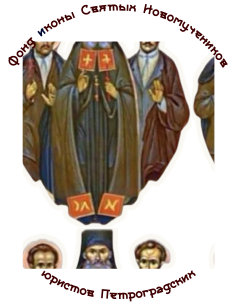
Foundation of the Icon
of the Holy New Martyrs –
Lawyers of Petrograd
< About Us >
Where Faith Meets
the Law
The Foundation of the Icon of the Holy New Martyrs – Lawyers of Petrograd was founded by Artem Dmitrievich Bakonin, an attorney-at-law and Candidate of Legal Sciences (Ph.D. in Law), at the intersection of two great traditions — Orthodox faith and Russian justice.
We gather under the protection of the icon those who devoted themselves to earthly law, yet lived according to God's law — lawyers who suffered martyrdom for Christ in the 20th century, namely Yuri Novitsky, Archimandrite Sergiy (Shein), and Ivan Kovsharov.
< About the Icon >
About the Icon
The initiator of the icon's creation was attorney Artem Bakonin (who previously served in the bodies of the General Prosecutor's Office of the Russian Federation). The author of the icon is Alexander Stalnov, head of the Icon Painting Department at the St. Petersburg Theological Academy. The iconography was developed from scratch; the authors studied the lives of the new martyrs and the materials of the Petrograd trial. They began by studying photographs, and then, in accordance with church tradition, they sought to discern how each person should be depicted on the icon.
The creation of this icon was carried out on the basis of a permit issued by the Synodal Commission on Icon Painting of the Russian Orthodox Church (Moscow Patriarchate), which confirms the canonicity and uniqueness of the painted image. The exclusive copyright to the image of the Holy New Martyrs – Lawyers of Petrograd belongs to the President of the Foundation, Artem Dmitrievich Bakonin. Thus, the icon of the Holy New Martyrs – Lawyers of Petrograd exists, and its legal status is fully regulated both by ecclesiastical and civil law.
The creation of this icon was carried out on the basis of a permit issued by the Synodal Commission on Icon Painting of the Russian Orthodox Church (Moscow Patriarchate), which confirms the canonicity and uniqueness of the painted image. The exclusive copyright to the image of the Holy New Martyrs – Lawyers of Petrograd belongs to the President of the Foundation, Artem Dmitrievich Bakonin. Thus, the icon of the Holy New Martyrs – Lawyers of Petrograd exists, and its legal status is fully regulated both by ecclesiastical and civil law.
Archimandrite Sergiy (Shein), Yuri Novitsky, and Ioann Kovsharov. The holy new martyrs were convicted in 1922 and sentenced to capital punishment (execution) in a case fabricated by the Bolsheviks regarding resistance to the seizure of church valuables. Eighty-six people were brought to trial, including Metropolitan Veniamin of Petrograd and Gdov (Kazansky). According to the authorities' scenario, all of them were involved in the disturbances that occurred during the confiscation of valuables from Petrograd's churches. The tribunal sentenced ten people to death, including Metropolitan Veniamin of Petrograd and Gdov, Archimandrite Sergiy (Shein), attorney I. M. Kovsharov, and Professor Yu. P. Novitsky.
They were charged with "disseminating ideas aimed against the implementation of the Soviet government's decree on the confiscation of church valuables, with the purpose of inciting popular unrest to create a united front with the international bourgeoisie against the Soviet government." The so-called Petrograd Trial took place in the hall of the former Noble Assembly (now the Grand Hall of the St. Petersburg Academic Philharmonia).
On July 5, 1922, the tribunal passed its verdict; subsequently, for six of the convicts, the death sentence was commuted to imprisonment. On the night of August 12–13 of that same year, Metropolitan Veniamin, together with Archimandrite Sergiy (Shein), and the laymen Yuri Novitsky and Ivan Kovsharov, were executed at the Rzhevsky firing range (on the outskirts of Petrograd) and buried in an unknown common grave. A cross has been erected over the symbolic grave of the Russian new martyrs at the fraternal cemetery of the Alexander Nevsky Lavra. In 1992, Archimandrite Sergiy Shein, Ivan Kovsharov, and Yuri Novitsky were canonized by the Russian Orthodox Church.
They were charged with "disseminating ideas aimed against the implementation of the Soviet government's decree on the confiscation of church valuables, with the purpose of inciting popular unrest to create a united front with the international bourgeoisie against the Soviet government." The so-called Petrograd Trial took place in the hall of the former Noble Assembly (now the Grand Hall of the St. Petersburg Academic Philharmonia).
On July 5, 1922, the tribunal passed its verdict; subsequently, for six of the convicts, the death sentence was commuted to imprisonment. On the night of August 12–13 of that same year, Metropolitan Veniamin, together with Archimandrite Sergiy (Shein), and the laymen Yuri Novitsky and Ivan Kovsharov, were executed at the Rzhevsky firing range (on the outskirts of Petrograd) and buried in an unknown common grave. A cross has been erected over the symbolic grave of the Russian new martyrs at the fraternal cemetery of the Alexander Nevsky Lavra. In 1992, Archimandrite Sergiy Shein, Ivan Kovsharov, and Yuri Novitsky were canonized by the Russian Orthodox Church.
The depiction on the icon of representatives of the clergy and the legal community is a symbol of the spiritual and legal unity of a revitalized Russia. The intertwining of their fates stands as an outstanding example of service to our Church and our Motherland — a feat in defending Truth, Justice, and the Rule of Law, even at the cost of their own lives.
The example of the new martyrs Archimandrite Sergiy, Yuri, and Ioann is a breath of fresh air and a ray of hope for lawyers in all fields. Judges, attorneys, prosecutors, investigators, businessmen, politicians — all who deal with the law — will find warmth and consolation in prayer before this icon.
The example of the new martyrs Archimandrite Sergiy, Yuri, and Ioann is a breath of fresh air and a ray of hope for lawyers in all fields. Judges, attorneys, prosecutors, investigators, businessmen, politicians — all who deal with the law — will find warmth and consolation in prayer before this icon.
The Meaning of Their Feat and Veneration
Holy New Martyrs –
Lawyers of Petrograd
Archimandrite Sergiy (Shein), Yuri Novitsky, and Ioann Kovsharov. The holy new martyrs were convicted in 1922 and sentenced to capital punishment (execution) in a case fabricated by the Bolsheviks regarding resistance to the seizure of church valuables. Eighty-six people were brought to trial, including Metropolitan Veniamin of Petrograd and Gdov (Kazansky). According to the authorities' scenario, all of them were involved in the disturbances that occurred during the confiscation of valuables from Petrograd's churches. The tribunal sentenced ten people to death, including Metropolitan Veniamin of Petrograd and Gdov, Archimandrite Sergiy (Shein), attorney I. M. Kovsharov, and Professor Yu. P. Novitsky.
They were charged with "disseminating ideas aimed against the implementation of the Soviet government's decree on the confiscation of church valuables, with the purpose of inciting popular unrest to create a united front with the international bourgeoisie against the Soviet government." The so-called Petrograd Trial took place in the hall of the former Noble Assembly (now the Grand Hall of the St. Petersburg Academic Philharmonia).
On July 5, 1922, the tribunal passed its verdict; subsequently, for six of the convicts, the death sentence was commuted to imprisonment. On the night of August 12–13 of that same year, Metropolitan Veniamin, together with Archimandrite Sergiy (Shein), and the laymen Yuri Novitsky and Ivan Kovsharov, were executed at the Rzhevsky firing range (on the outskirts of Petrograd) and buried in an unknown common grave. A cross has been erected over the symbolic grave of the Russian new martyrs at the fraternal cemetery of the Alexander Nevsky Lavra. In 1992, Archimandrite Sergiy Shein, Ivan Kovsharov, and Yuri Novitsky were canonized by the Russian Orthodox Church.
The depiction on the icon of representatives of the clergy and the legal community is a symbol of the spiritual and legal unity of a revitalized Russia. The intertwining of their fates stands as an outstanding example of service to our Church and our Motherland — a feat in defending Truth, Justice, and the Rule of Law, even at the cost of their own lives.
The example of the new martyrs Archimandrite Sergiy, Yuri, and Ioann is a breath of fresh air and a ray of hope for lawyers in all fields. Judges, attorneys, prosecutors, investigators, businessmen, politicians — all who deal with the law — will find warmth and consolation in prayer before this icon.
About the Icon
Creation
The initiator of the icon's creation was attorney Artem Bakonin (who previously served in the bodies of the General Prosecutor's Office of the Russian Federation). The author of the icon is Alexander Stalnov, head of the Icon Painting Department at the St. Petersburg Theological Academy. The iconography was developed from scratch; the authors studied the lives of the new martyrs and the materials of the Petrograd trial.
They began by studying photographs, and then, in accordance with church tradition, they sought to discern how each person should be depicted on the icon. The creation of this icon was carried out on the basis of a permit issued by the Synodal Commission on Icon Painting of the Russian Orthodox Church (Moscow Patriarchate), which confirms the canonicity and uniqueness of the painted image.
The exclusive copyright to the image of the Holy New Martyrs – Lawyers of Petrograd belongs to the President of the Foundation, Artem Dmitrievich Bakonin. Thus, the legal status is fully regulated both by ecclesiastical and civil law.
< About the Icon >
Our Values
· Synthesis of Faith and Law: we affirm that Christian conscience and legal professionalism do not contradict but complement each other.
· Veneration of the New Martyrs: the saints who were lawyers are the best intercessors for those who today administer justice or defend the rights of others.
· The Image as a Bridge: for us, the icon is not merely a sacred object, but a symbol of the union of heavenly patronage with the earthly service of a lawyer.
· Veneration of the New Martyrs: the saints who were lawyers are the best intercessors for those who today administer justice or defend the rights of others.
· The Image as a Bridge: for us, the icon is not merely a sacred object, but a symbol of the union of heavenly patronage with the earthly service of a lawyer.
Our Mission
To make the icon of the holy new martyrs – lawyers a point of convergence between the Church and the legal profession. We help churches and courts, bar associations and university law faculties, prosecutors and investigators, notary chambers and law enforcement agencies, politicians and businessmen, to receive this sacred image, so that it may serve as a reminder: a true lawyer serves the letter of the Law and the Truth that is rooted in faith.
«This icon is the intersection
of faith and law.»
Фонд Иконы Святых Новомучеников юристов Петроградских» создан Бакониным Артемом Дмитриевичем, адвокатом, кандидатом юридических наук, на стыке двух великих традиций — православной веры и российского правосудия.
Мы собираем под покровом иконы тех, кто посвятил себя закону земному, но при этом жил по закону Божию, — юристов, принявших мученическую кончину за Христа в XX веке, а именно Юрия Новицкого, архимандрита Сергия Шейна, Иван Ковшарова.
< What the Foundation Does >
Connecting the Altar
and the Judge's Chair
The Foundation's activity revolves around the Icon of the Holy New Martyrs – Lawyers of Petrograd. We work at the intersection of church life and legal practice, using this sacred image to strengthen the bond between these two spheres.
Prayerful Support for the Legal Community
We organize molebens (prayer services) and akathists before the icon located in the Kazan Cathedral and the Church of the Nativity of Christ on the Sands in St. Petersburg, to which we invite judges, attorneys, investigators, and law students. In this way, we connect everyday professional life with prayerful intercession before the saints who themselves walked the path of both lawyer and martyr.
Enlightenment on the Inseparability of Faith and Law
We hold meetings, lectures, and roundtables where priests, lawyers, and historians discuss how Christian commandments relate to legal duty. At the heart of these conversations are the lives of the new martyrs, who demonstrated that being a lawyer by calling and being a believer are one and the same.
Creation and Distribution of the Icon to Churches and Legal Institutions
We commission and consecrate the icon, which is equally fitting in an altar, a courtroom, or a lawyer's office. The Foundation distributes it:
· to churches — for the prayerful commemoration of those working in the judicial system;
· to courts, arbitration courts, prosecutor's offices, and notary chambers — as a reminder of the moral foundation of justice;
· to bar associations and law schools — so that they may see before them an example of serving the truth, for which the saints gave their lives.
Do you need support from the Foundation?
Write to us by email
Swipe >
< Our Projects >
Projects on the Edge
of Two Worlds
Icon to the Church —
Icon to the Court
A program through which the same image of the holy new martyrs – lawyers finds its place both in the church and in the courtroom. We accompany the transfer of the icon with a brief word about how Law without Faith becomes cruel, and Faith without Law cannot defend truth in earthly matters.
Holy Lawyers —
Heavenly Patrons
A publishing project: we produce small books and brochures with the lives of the new martyrs — graduates of the School of Jurisprudence, sworn attorneys, and judges. They show how faith permeated their professional activities. These books and brochures are distributed among lawyers, students, in courts, and in churches.
Council of Faith
and Law
A permanent platform where clergy and prominent lawyers discuss pressing issues of modern law enforcement from the perspective of Christian morality. The meetings are held before the icon of the new martyrs, emphasizing that any professional decision needs spiritual support.
Icon as a Gift to
the Law Faculty
A special project for educational institutions. We present the icon of the holy new martyrs – lawyers to university churches or lecture halls, so that future legal scholars, from their very first steps in the profession, may see the example of those who combined deep faith and service to the law.
< Catalog >
Purchase the Icon
Icon of the Holy New Martyrs –
Lawyers of Petrograd
The Icon of the Holy New Martyrs – Lawyers of Petrograd is handcrafted in an antique style: noble brushed wood, dovetail joints, a precise image, and a protective varnish coating. It has been consecrated. More than just an antiquity — it is your personal guardian and intercession for those who serve the law and truth.
The icon is available in three sizes:
13×17 cm — 1500 RUB
20×30 cm — 3000 RUB
30×50 cm — 5000 RUB
< History >
The Petrograd Trial: why were the lawyers killed in 1922?
They did not steal, they did not kill. They were faithful to their oath and to God. The outcome — a firing squad.
Why does the Foundation of the Icon of the New Martyrs – Lawyers remind us of this today? Because without historical memory, any law becomes a weapon in the hands of lawlessness. The video contains documents, names, and a connection to our time.
Support the Foundation's Mission
Do you want to help strengthen the moral foundations of justice and preserve the memory of the holy new martyrs?
Your support will allow us to:
Create and distribute icons to churches and legal institutions
Organize prayer services and educational meetings
Develop dialogue between spiritual and legal communities
Make a Donation
Фонд Иконы Святых Новомучеников юристов Петроградских» создан Бакониным Артемом Дмитриевичем, адвокатом, кандидатом юридических наук, на стыке двух великих традиций — православной веры и российского правосудия.
Мы собираем под покровом иконы тех, кто посвятил себя закону земному, но при этом жил по закону Божию, — юристов, принявших мученическую кончину за Христа в XX веке, а именно Юрия Новицкого, архимандрита Сергия Шейна, Иван Ковшарова.
< News >
Swipe >
Serving the Truth: A Chronicle of Activities
This section is dedicated to the implementation of the mission of the Foundation of the Icon of the Holy New Martyrs – Lawyers of Petrograd — strengthening the bond between spiritual traditions and legal practice.
Stay with us to follow how the ideas of morality and service to the truth are embodied in concrete deeds.
ST. PETERSBURG. MINISTRY OF JUSTICE OF RUSSIA
Today, a working meeting was held at the Main Directorate of the Ministry of Justice of the Russian Federation for St. Petersburg and the Leningrad Region between the President of the Foundation of the Icon of the Holy New Martyrs – Lawyers of Petrograd, Artem Dmitrievich Bakonin, and the Head of the Directorate, Evgeny Anatolyevich Orlovsky.
During the meeting, a number of issues related to the implementation of the project for the installation of the monument to the holy lawyers were discussed.
Let us recall: on June 23, 2026, the foundation stone of the future monument to the holy lawyers was laid in Polustrovsky Park in St. Petersburg. The initiative for its construction belongs to the Minister of Justice of the Russian Federation, Konstantin Anatolyevich Chuychenko.
MOSCOW. TRANSPORT PROSECUTOR'S OFFICE
A working meeting was held at the office of the Moscow Interregional Transport Prosecutor's Office between the President of the Foundation of the Icon of the Holy New Martyrs – Lawyers of Petrograd, Artem Dmitrievich Bakonin, and the Deputy Prosecutor, Senior Counselor of Justice, Denis Alexandrovich Shevchenko.
They discussed upcoming joint projects and preparations for the grand opening of the monument to the holy new martyrs – lawyers in Polustrovsky Park in St. Petersburg.
Together we continue the work of preserving historical memory and strengthening the legal traditions of Russia.
THE LENINGRAD REGION
UNDER PROTECTION
Today, a working meeting was held at the Administration of the Leningrad Region between the President of the Foundation of the Icon of the Holy New Martyrs – Lawyers of Petrograd, Artem Dmitrievich Bakonin, and the Vice-Governor of the Leningrad Region, Denis Stanislavovich Sedov.
At the beginning of the meeting, the Icon of the Holy New Martyrs – Lawyers of Petrograd was presented to the Vice-Governor of the Leningrad Region.
During the conversation, the prospects for joint work on preserving the historical memory of the new martyrs and spiritual and moral enlightenment were discussed.
The Leningrad Region is under the protection of the holy new martyrs: Archimandrite Sergiy, Ioann Kovsharov, and Yuri Novitsky.
224 YEARS OF THE MINISTRY OF JUSTICE OF RUSSIA!
On September 8, 1802, Emperor Alexander I signed the Manifesto on the Establishment of Ministries. From that day began the history of the agency that stands guard over the Law.
Today I am in Moscow. On the birthday of the Ministry of Justice, I am attending the consecration of an icon painted specifically for the Ministry of Justice, together with the Minister of Justice of the Russian Federation, Konstantin Anatolyevich Chuychenko.
The consecration of the Icon of the Holy New Martyrs – Lawyers of Petrograd is a symbolic act. We are opening a new page in the history of a Legal Russia.
Happy Birthday, Ministry of Justice!
MONUMENT CONSTRUCTION — UNDER CONTROL
Today, under the chairmanship of the Vice-Governor of St. Petersburg, Evgeny Nikolaevich Razumishkin, a working meeting of all city services was held to discuss the installation of the monument to the holy new martyrs – lawyers of Petrograd in Polustrovsky Park. This project is an initiative of the Minister of Justice of the Russian Federation, Konstantin Anatolyevich Chuychenko.
All details were discussed — from technical documentation and territory improvement to logistics. This is a crucial stage of the project, which will transform the memory of the feat of Archimandrite Sergiy, Ioann Kovsharov, and Yuri Novitsky into a tangible symbol of the Legal Capital of Russia — our legal St. Petersburg. Before the start of the meeting, the President of the Foundation of the Holy Lawyers, Artem Dmitrievich Bakonin, presented the icon of the new martyrs to Vice-Governor Evgeny Nikolaevich Razumishkin. We thank Evgeny Nikolaevich for his dedication and systematic approach aimed at the successful implementation of the project.
TWO SHRINES — IN ONE DAY
Today, the Kazan Cathedral in St. Petersburg is a day of great grace! The relics of St. Spyridon of Trimythous have arrived in the city.
And right here, today, within the walls of the city's main cathedral, the President of the Foundation of the Icon of the Holy New Martyrs – Lawyers, Artem Dmitrievich Bakonin, together with Archpriest Alexander Pashkov — Chairman of the Parish Council of the Kazan Cathedral — presented the Icon of the Holy New Martyrs – Lawyers of Petrograd to the Chairman of the Legislative Assembly of St. Petersburg, Alexander Nikolaevich Belsky.
The meeting of the two shrines — the relics of St. Spyridon and the icon of the holy lawyers — is a sign of heavenly blessing for our city, for a legal St. Petersburg.
SPBILF-2026: A MEETING OF TWO GREAT FORCES!
On the final day of the St. Petersburg International Legal Forum, a meeting took place with the People's Artist of Russia, film director, and Chairman of the Union of Cinematographers of the Russian Federation, Nikita Sergeevich Mikhalkov. During the conversation, they discussed a film project dedicated to the feat of the holy new martyrs – lawyers of Petrograd, who in 1922 did not renounce their faith and accepted martyrdom for the truth. Nikita Sergeevich supported the idea of creating a film, and joint steps were outlined to realize this vision. At the conclusion of the meeting, the President of the Foundation of the Holy New Martyrs – Lawyers of Petrograd, attorney Artem Dmitrievich Bakonin, presented Nikita Sergeevich Mikhalkov with the icon of the holy new martyrs – lawyers of Petrograd as a symbol of the connection between faith, law, and art. SPBILF is ending, but our common cause is only gaining momentum!
Foundation Stone Laying of the Memorial to the Holy New Martyrs – Lawyers of Petrograd
The President of the Foundation, Artem Bakonin, together with the Minister of Justice of the Russian Federation Konstantin Chuychenko and the Governor Alexander Beglov, laid the foundation of the future monument in Polustrovsky Park. During the solemn ceremony, Metropolitan Barsanuphius performed the rite of consecration of the stone of the six-meter memorial in honor of the defenders of the faith — Archimandrite Sergiy (Shein), Yuri Novitsky, and Ioann Kovsharov. The ceremony took place in a profound, symbolic atmosphere: "A monument is not just a stone — it is a bridge between eras." On the eve of SPBILF-2026, St. Petersburg is finally ceasing to be "criminal" and is becoming the Legal Capital of Russia. The memory has been restored. The work continues.
FAITH, HOCKEY, FRIENDSHIP
The President of the Foundation of the Icon of the Holy New Martyrs – Lawyers of Petrograd, Artem Bakonin, arrived in Moscow for a friendly meeting with hockey legend — the President of the KHL, Alexey Morozov. Today, during the meeting, Alexey Alexeyevich was presented with the Icon of the Holy New Martyrs – Lawyers of Petrograd — depicting Archimandrite Sergiy (Shein), Yuri Novitsky, and Ioann Kovsharov. The meeting was held in a warm, informal atmosphere. They discussed not only hockey and the development of sports in the country, but, most importantly, the possibility of joint projects for the near future. We unite faith, law, and sports. The friendship between the Foundation and the KHL is reaching a new level.
The Power of Faith and Law — Within the Walls of the Rosgvardia Academy
Today, May 21, 2026, an event uniting the spiritual and the state took place at the Order of Zhukov Military Academy of the National Guard Troops of the Russian Federation. The President of the Foundation of the Icon of the Holy New Martyrs – Lawyers of Petrograd, Artem Dmitrievich Bakonin, solemnly presented the holy icon to: Sergei Vadimovich Stepashin — an outstanding statesman, politician, and public figure; and Andrei Yuryevich Kiiko — the Head of the Academy, Lieutenant General of the Russian National Guard. Faith. Honor. Law.
Kresty
Today, the President of the Foundation of the Icon of the Holy New Martyrs – Lawyers of Petrograd, Artem Dmitrievich Bakonin, met with the head of the pre-trial detention center and the rector of the church at Kresty. On behalf of the Foundation, he presented the icon of the holy lawyers. Kresty is not just a prison. It is a place where everything is harsh and transparent. The absolute point of exit from the comfort zone. Here, just like in war or in a hospital, you begin to believe for real. Not falsely, not for show. To the point of trembling. In God. In the Law. In concepts that are above you. Only here do you begin to change yourself. If you haven't understood before — you will. The icon came here to an address where it was expected.
Tver / St. Petersburg
Today, May 8, a momentous event took place at the Transfiguration Cathedral in Tver. The President of the Foundation of the Icon of the Holy New Martyrs – Lawyers of Petrograd, Artem Dmitrievich Bakonin, presented a copy of the holy icon to Metropolitan Ambrose of Tver and Kashin. The original of this icon, depicting Archimandrite Sergiy (Shein) and the martyrs Yuri Novitsky and Ivan Kovsharov, who were shot in 1922 for their faith and truth, is permanently kept at the St. Petersburg Church of the Nativity of Christ on the Sands. Now its precise copy has arrived on Tver soil — the small homeland of the President of Russia, Vladimir Putin, where his ancestors were born. "All my ancestors are from the Tver region," the head of state has emphasized more than once. On the same day, in recognition of his labors for the glorification of the memory of the new martyrs and confessors of the Russian Church, Artem Dmitrievich Bakonin was awarded the Medal of the Holy Martyr Thaddeus, Archbishop of Tver — a high honor of the Tver diocese.
Konevsky Monastery – A Place of Power
Today, the President of the Foundation of the Icon of the Holy New Martyrs – Lawyers of Petrograd, attorney Artem Bakonin, presented a copy of the priceless icon of the saints to the abbot of the Konevsky Nativity of the Theotokos Monastery, Archimandrite Alexander (Arva). Since 1393, the monastery has been a place of concentrated faith and strength. From now on, believers here will be able to pray before the Icon of the Holy New Martyrs – Lawyers of Petrograd for just and lawful decisions. The shrine will be placed in the left chapel of the monastery's main cathedral. It is noteworthy that the grand revival of the monastery began with a visit by the guarantor of the Russian Constitution — the President of Russia, Vladimir Vladimirovich Putin.
A Symbiosis of Jurisprudence and Orthodoxy: A Meeting at the Church on the Sands
Today, April 16, a working meeting was held at the Church of the Nativity of Christ on the Sands in St. Petersburg between the President of the Foundation of the Icon of the Holy New Martyrs – Lawyers of Petrograd, attorney and Candidate of Legal Sciences Artem Dmitrievich Bakonin, and the Director of the St. Petersburg Institute (branch) of the All-Russian State University of Justice (VGUU) of the Ministry of Justice of Russia, Danil Vyacheslavovich Rybin. During the meeting, they discussed prospects for joint work on the spiritual, moral, and patriotic education of law students, as well as issues of preserving the historical memory of the new martyrs. As a sign of spiritual connection and for the benefit of future projects, the Icon of the Holy New Martyrs – Lawyers of Petrograd was presented as a gift to the institute.
A Conference "State and Church in Russian History" Was Held at the Mariinsky Palace
St. Petersburg, March 26, 2026 — The All-Russian Scientific and Practical Conference "State and Church in Russian History" was held at the Mariinsky Palace — the headquarters of the Legislative Assembly of St. Petersburg. The event brought together historians, legal scholars, public figures, and clergy to reflect on the complex pages of the relationship between the state and the Church, as well as their role in the formation of Russian statehood.
Working Meeting at the Krutitsy Patriarchal Compound.
The President of the Foundation of the Icon of the Holy New Martyrs – Lawyers of Petrograd, Artem Bakonin, visited the Krutitsy Patriarchal Compound in Moscow, where he held a working meeting with Archpriest Sergiy Shastin. The main topic of the talks was the discussion of joint projects involving the Foundation of the Icon of the Holy New Martyrs – Lawyers of Petrograd. The parties considered opportunities for cooperation in the field of educational activities and agreed on further steps to develop partnership relations.
Today, February 5, a Truly Significant Event Took Place.
A festive moleben (prayer service) was held at the Church of the Nativity of Christ on the Sands in honor of the feast day of St. Paul of Obnorsk (Komelsky) — a disciple of St. Sergius of Radonezh and founder of the Komelsky Monastery in the Vologda region. The moleben was led by the rector of the church, Archpriest Andrey Shcherban. Representatives of the Foundation of the Icon of the New Martyrs – Lawyers of Petrograd also took part in the service: Foundation President Artem Bakonin and Founder Alexey Lelyukh. The presence of representatives of the Foundation, dedicated to the memory of the new martyrs and confessors of the Russian Church (specifically lawyers), indicates the connection between the veneration of the ancient ascetics of the faith and the memory of those who suffered for their faith in the 20th century. This underscores the continuity of the spiritual tradition.
Today, a Ceremony of Icon Presentation Was Held in a Unit of the Russian Ministry of Defense of the Leningrad Military District
The icon was presented to officers who had arrived from the zone of the Special Military Operation (SMO), as well as those who had been wounded and awarded state decorations for their courage and heroism in the performance of their military duty. The officers, whose merits have been recognized with state awards, as a sign of respect and gratitude from the command, underscore the significance of the contribution of military personnel to ensuring state security and fulfilling their assigned tasks.
Final Meeting of the Foundation Delegation in Belgrade
Belgrade, Serbia — The final meeting within the framework of the working visit of the Russian delegation, dedicated to the 81st anniversary of the Great Victory, was held at the office of the State Duma of Serbia. The President of the Foundation of the Icon of the Holy New Martyrs – Lawyers of Petrograd, attorney and Candidate of Legal Sciences Artem Dmitrievich Bakonin, presented the icon of the holy new martyrs to the Deputy Chairman of the State Duma of the Republic of Serbia, Professor Dr. Jovan Janić. The meeting took place in a warm, friendly atmosphere and became a symbolic conclusion to the delegation's eventful program in Serbia. The interlocutors summarized the results of the past days.
Belgrade: Continuation of the Russian Delegation's Visit
The President of the Foundation of the Icon of the Holy New Martyrs – Lawyers of Petrograd, attorney and Candidate of Legal Sciences Artem Dmitrievich Bakonin, at the residence of the Ambassador Extraordinary and Plenipotentiary of the Republic of Belarus to Serbia, Sergei Malinovsky, solemnly presented him with the icon of the holy new martyrs. The meeting was held in a warm, trusting atmosphere. The presentation of the icon became a sign of deep respect for the fraternal Belarusian people and a symbol of shared historical memory of the feat of the defenders of faith and law.
Belgrade: Conference for the 81st Anniversary of the Great Victory
Right now, a landmark event is taking place on the sidelines of the forum. The President of the Foundation of the Icon of the Holy New Martyrs – Lawyers of Petrograd, attorney and Candidate of Legal Sciences Artem Dmitrievich Bakonin, solemnly presented the icon of the holy new martyrs. The shrine was given to: — the official representative of His Holiness Patriarch Porfirije of Serbia — His Grace Bishop Dosifej of Lipljan; — the Embassy of the Russian Federation, represented by Ambassador Extraordinary and Plenipotentiary Alexander Arkadyevich Botsan-Kharchenko; — the Chairman of the International Foundation for the Spiritual Unity of Peoples, Professor Valery Alekseev.
A Meeting of Metropolitan Sergiy with Foundation Representatives Took Place in Barnaul
Barnaul, March 20, 2026 — A working meeting was held at the Barnaul Diocesan Administration between the head of the Altai Metropolis, Metropolitan Sergiy of Barnaul and Altai (Ivannikov), and a delegation of the Foundation of the Icon of the Holy New Martyrs – Lawyers of Petrograd, led by the Foundation's President, attorney and Candidate of Legal Sciences Artem Dmitrievich Bakonin. During the visit, which became an important milestone in the development of the Foundation's interregional cooperation, the guests presented the Icon of the Holy New Martyrs – Lawyers of Petrograd as a gift to the Altai Cathedral.
Russia's First Icon of the Patron Saints of Lawyers
St. Petersburg has unveiled Russia's first icon of the patron saints of lawyers. ST. PETERSBURG, January 23, 2026 — A historic event for the Orthodox legal community took place today at the Holy Trinity Alexander Nevsky Lavra. Metropolitan Barsanuphius of St. Petersburg and Ladoga presented the Icon of the Holy New Martyrs – Lawyers of Petrograd to the Minister of Justice of the Russian Federation. The ceremony was also attended by the President of the Foundation, attorney A.D. Bakonin. This is the first time in Russian history that an icon considered the patroness of all Orthodox lawyers and those involved in the application of law has been recognized at such a high official level. The image is intended to symbolize the spiritual foundations of law and service to justice.
Heartfelt Congratulations on the Nativity of Christ!
Today, on January 8, a solemn Divine Liturgy was held at the Church of the Nativity of Christ on the Sands in St. Petersburg. It was led by Metropolitan Barsanuphius of St. Petersburg and Ladoga, with the participation of Bishop Benjamin of Kronstadt, vicar of the St. Petersburg diocese. Special attention was given to representatives of the spiritual community. The President of the Foundation of the Icon of the Holy New Martyrs – Lawyers of Petrograd, Artem Dmitrievich Bakonin, was awarded the high distinction — the Order of the Holy Martyr Benjamin, Metropolitan of Petrograd — for his significant contribution to the life of the St. Petersburg Metropolis.
Alexey Alexandrovich Lelyukh
Founder of the Foundation of the Icon of the Holy New Martyrs – Lawyers of Petrograd
< Contacts >
If you need assistance:
TIN 7806632350
KPP 780601001
OGRN 1257800103505
Certificate of state registration of a non-profit organization No. 7814013165, issued by the Main Directorate of the Ministry of Justice of the Russian Federation for St. Petersburg and the Leningrad Region on November 19, 2005.
The Foundation operates in accordance with the Constitution of the Russian Federation, legislative and regulatory acts, Decree of the President of the Russian Federation No. 809 of November 9, 2022, as well as the blessing of Metropolitan Barsanuphius of St. Petersburg and Ladoga.
We use cookies to ensure the best experience on our website.